1. Introduction
More than a passing trend, urban agriculture (UA) has become a part of modern cities. According to some authors, it provides some ecosystem services (well-being, food, carbon storage, water catchment, biodiversity…) contributing to creating more liveable cities and fostering climate resilience (Aubry et al., 2022). Although these functions are recognised, they cannot be generalised. The various forms of urban agriculture (e.g. urban domestic gardens, allotment and community gardens, multifunctional urban micro-farms, peri-urban farm in short chain) provide specific services. Home gardens, despite the non-commercial nature of food production can also contribute to the food and ecological resilience of cities by reducing the vulnerability of households in the event of economic, supply or other insecurity crises (Seeth et al., 1998, Buchmann, 2009, Cerda et al., 2022) and by providing a range of ecosystem services (Cameron et al., 2012).
Reliable methodologies to characterise and quantify these services and their interactions are still lacking. Concerning the contribution of UA to food resilience, the literature is fragmented and not consensual. The estimations depend on UA forms and the calculation methods (Marie, 2019, Payen et al., 2022). It is even more complex to understand the correlations between functions. For example, there are still discussions with respect to the environmental efficiency of urban agriculture, which is questioned (Goldstein et al., 2016) and vary according to growing systems and agricultural practices (Hawes et al., 2024). As a result, statements are highly variable, and may be conflicting, depending on the context, practices and methods used. Despite this context of scientific ‘uncertainty’ and the absence of robust methods for calculating and evaluating their contribution, local stakeholders enhance and implement agricultural activities into urban and peri-urban areas to expect different functions. The proliferation of public actions in favour of the development of UA seems to be mainly motivated by the potential contributions expected from the various UAs in accelerating territorial transitions (food, environment, agriculture) and climate resilience.
In our study, we question the integration of urban agriculture (UA) and urban domestic gardens (UDG) in the design of urban planning. We aim to demonstrate how urban agriculture is being integrated into urban planning, and what functions it may fulfil. How do municipalities integrate UA and UDG in territorial projects? Which issues and functions are related to UA and UDG? How does the territorial context determine the consideration for those functions? We believe this research may contribute to a better understanding of barriers and levers for greening cities in a perspective of climate resilience.
2. Co-benefits of urban green and cultivated spaces for climate, environmental and territorial resilience
On an international scale, cities have a major role to play in mitigating and adapting to climate change, insofar as they concentrate the majority of greenhouse gas emissions, while also concentrating the majority of the world's population suffering the effects of climate change.
In Europe, the Union's recommendations and the policies of the Member States have led to the introduction of climate action plans at national, regional and city level, in particular to reduce carbon emissions (Amundsen et al., 2018). These action plans directly raise the question of the link between climate policies and urban planning policies.
At the same time, the European Commission is encouraging Member States to include green infrastructure in their national guidelines on biodiversity conservation strategies and sustainable urban planning. Urban green spaces are thus identified as levers for providing ecosystem services and implementing nature-based solutions for adapting to climate change (EC, 2014).
With a view to limiting land take, urban studies since the 1990s have highlighted the concept of the compact city, which is based on the densification of housing, multifunctional uses and sustainable forms of mobility (Hautamäki et al., 2024). Many studies consider the compact city model to be the most appropriate for meeting sustainability requirements (Bibri et al., 2020). In particular, it is seen as relevant from the perspective of the climate resilience of cities. In fact, it suggests ways of limiting the consumption of agricultural/natural spaces and of reducing the energy balance of cities (Artmann et al., 2019).
The literature review by Berghauser Pont et al (2021) shows, however, that the effects of the compact city remain controversial in terms of sustainable development, particularly concerning climate resilience and preservation of biodiversity. The question is therefore not so much whether the compact city is sustainable, but what forms of compact city would be compatible with sustainability, including the preservation of biodiversity.
More generally, the academic literature emphasises the relationship between biodiversity conservation and climate resilience (Pettorelli et al., 2021). From this perspective, urban green infrastructure is seen as a source of co-benefits (Malico et al., 2016).
A major challenge for urban studies is therefore to consider the ways in which the compact city and the green city can coexist in a perspective of climate resilience (Hautamäki et al., 2024). This coexistence implies adopting a systemic approach to urban planning, without reducing climate change mitigation to energy and mobility issues, but taking a broad view of the ecosystem services provided by green infrastructure in all its forms (parks, green paths, collective and private gardens). This means identifying trade-offs and forms of densification that are compatible with the preservation of green spaces in the city.
The climate services provided by urban agriculture are highlighted in the literature, either in relation to the services provided by urban greening in general, or more specifically in relation to urban agriculture. A study conducted in the Ile-de-France region shows the effect of urban greening on reducing the heat island effect by highlighting its cooling impacts (de Munck et al., 2018). Forms of urban agriculture have potentially similar effects (Goldstein et al., 2016). The impact is greater in the case of ground vegetation than in the case of green roofs (Ng et al., 2012) (Jansson et al., 2007; Bowler et al., 2010; Chang and Li, 2014; Feyisa et al., 2014). Urban agriculture also provides climate services through indirect effects. Green roofs help reduce energy consumption (for heating homes in winter or cooling them in summer). This is an indirect positive effect, as energy emissions contribute to the urban heat island phenomenon. This effect is particularly significant when buildings are poorly insulated (Niachou et al., 2001; Jaffal et al., 2012; Sisco et al., 2017).
In general, the cooling effect of urban agriculture varies greatly depending on the area occupied, the type of crop and the surrounding urban environment (Mancebo, 2018). Urban agriculture, like all forms of agriculture, can also contribute to carbon storage in the soil, which helps regulate the climate. Studies have been conducted in the US and France on this storage potential on urban rooftop gardens and urban soils (Whittinghill et al., 2014; Cambou et al., 2018). Here again, this potential varies depending on soil type, agricultural practices and climate conditions. Finally, it should be remembered that one of the effects of climate change is an increase in natural hazards and extreme events, particularly in terms of precipitation and flooding. Through rainwater infiltration and reduced runoff, urban agriculture helps reduce the impact of flooding on urban infrastructure (damage to sewer systems) and natural environments (waterways) (Aubry et al., 2022).
3. Greening cities and fostering climate resilience in a context of no net land take policies in France
The European Union has defined a European adaptation strategy that sets out guidelines for 2050 (European Commission, 2021). These recommendations are intended to guide the actions of Member States, as well as local planning authorities.
In France, the debate on sustainable cities has been profoundly impacted by legislation on planning and environment in the late 2000s, known as the “Grenelle laws” (2009-2010). This legal framework promoted the integration of environmental and climate objectives in planning policies. It was implemented through a national action plan for “sustainable cities” (Plan Ville Durable, 2010), which included the program "Restoring and enhancing nature in the city" initiated by the French State Secretary for Ecology.
The inclusion of climate change objectives in urban planning has been a feature of French legislation since the Grenelle laws and has been progressively strengthened up to the latest major law on the subject, the Climate and Resilience Act of 2021. The French Urban Planning Code sets out the principle that the action taken by local planning authorities ‘contributes to the fight against climate change and to adapting to this change’ (article L. 110). This integration has been gradual, insofar as the legislation initially focused on the issue of mitigation (reducing emissions) and only more recently addressed the question of adaptation, particularly through the fight against heat islands.
French legislation has also introduced territorial planning instruments specifically dedicated to climate action and designed as the local version of the national ‘climate plan’ introduced in 2004: ‘territorial climate-energy-air plans’ (hereinafter referred to as ‘climate plans’), which have been renamed several times to take account of the issues of air quality and energy frugality. Climate plans are designed at the level of inter-municipal authorities. Initially, these instruments do not come directly under urban planning law, but the links are often close. For example, the framework document that organises climate plans at regional level, initially designed as an autonomous ‘regional climate plan’, was incorporated into the regional urban planning scheme in 2015.
Climate plans are part of the strategic planning process, which aims to organise and coordinate the actions of local planning authorities at local level. Urban planning (local land-use plans in particular), on the other hand, is regulatory in scope and has a direct impact on building rights and therefore property values. But this legal distinction is not strict, insofar as the legislation requires that the objectives of regulatory urban planning include the actions prescribed by strategic climate planning (Marie, 2024) (Desjardins, 2011).
Since the Climate and resilience Act in 2021, local land-use plans (plan local d'urbanisme), drawn up by municipalities on a communal or inter-communal scale, have had to ensure that they are compatible with local climate plans. In terms of climate action, urban planning may include, for example, provisions to encourage the preservation of undeveloped areas, green spaces and ecological continuities. However, this integrated planning remains limited, since taking climate objectives into account in urban planning choices generally translates legally into a simple obligation of means and not an obligation of results. In other words, local authorities need to reflect consideration and response to climate goals in their planning, but they do not bear mandatory legal responsibility for ultimately achieving specific results. Ten years later, in 2020, the Ministry of Social and Ecological Transition and the Ministry of Territorial Cohesion launched a new ‘roadmap for the city of tomorrow’. In this context, the National Agency for Urban Renewal (Agence Nationale de la Rénovation Urbaine) started in 2020 a call for "Fertile Neighborhoods", to support urban agriculture in deprived districts.
These urban planning policies identify UA as a lever for urban transformation in several dimensions of territorial resilience which are economic (promoting the attractiveness of neighbourhoods through job creation), social (through improved living conditions and social cohesion), and environmental (through the preservation of natural resources and climate resilience). This transformative capacity of UA is also highlighted by the French Economic, Social and Environmental Council (CESE) in its opinion on "Urban agriculture". However, the CESE's recommendations point to the need to better integrate UA into regional planning, and to develop policies and projects that complement peri-urban and rural agriculture (in particular, food planning projects, in French “Plans alimentaires territoriaux”, see also article <food system planning> in this special issue). These recommendations suggest adapting the legal, regulatory (local land-use plans, zoning, building design) and tax regulations, as well as research into sustainability by taking into account the diversity of UA forms in order to promote sustainable development on a territorial scale. As noted by Consalès et al. (2018) it seems that only allotment gardens are truly integrated into land-use plans.
More recently, planning policies in France have moved to quantitative objectives regarding land take limitation. The Climate and Resilience Act 2021 set out a binding objective of “no net land take” (“Zéro artificialisation nette”), fostering a renewed interest for conciliation between urban densification and preservation of green and cultivated spaces. The Climate and Resilience Act explicitly defines a link between issues that may previously have appeared separate in planning law: climate action, limiting land consumption, preserving urban biodiversity and greening cities. The 2021 Act explicitly links urban planning to climate policies. It jointly mentions the objectives of preserving non-artificialized land, renaturating artificialized land and preserving urban biodiversity as objectives that should guide the design of urban planning.
The link between these different issues can be clearly seen in the definition given of ‘artificialisation’: ‘artificialisation is defined as the lasting alteration of all or part of the ecological functions of land, in particular its biological, hydric and climatic functions’ (article 192, Climate and Resilience Act, 2021). Urban green spaces and urban agriculture are therefore at the crossroads of some very topical urban planning issues, and raise the question of how to reconcile the models of the compact city and the green city to achieve climate resilience.
In our study, we explore various forms of urban agriculture. Urban agriculture have given rise to typologies based on several criteria: location of agricultural productions, stakeholders involved (professional urban famers, inhabitants, associations), nature of agricultural productions, type of soil used (existing soil or imported soil), distribution and marketing systems, economic and social model. In France, a widely used typology distinguishes between five forms of urban agriculture: peri-urban farms, multi-functional micro-farms, indoor urban agriculture, community gardens and, finally, private gardens. This typology takes into account spatial dimensions (location) and the objectives of local initiatives in this area (commercial productions, non-commercial exchange services within the voluntary sector). Depending on these objectives, the associated functions and development needs are not the same (Aubry et al., 2022).
4. Methods
This article is based on two lines of work carried out by the authors: one specifically on urban domestic gardens and others on urban collective agriculture. Our article is based on two different objects of study: 1) private domestic gardens on individual housing plots in urbanised areas and, 2) urban collective agriculture’s forms: allotment gardens, community gardens, and urban microfarms (Fig.1).
Fig. 1 Urban Agriculture's Forms
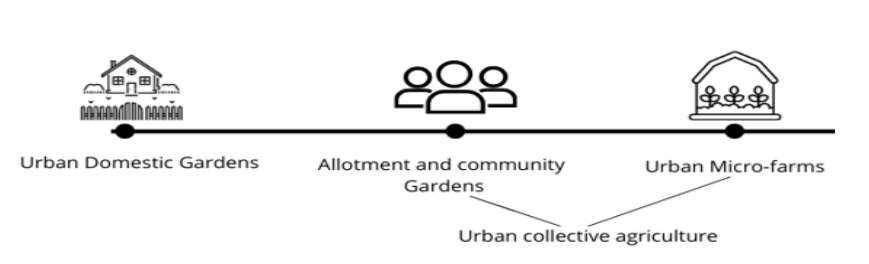
Although distinct, the two surveys both question the integration of those forms of urban agriculture into urban planning at municipal level within the Ile-de-France region). The scope of the study focuses on urban planning documents respectively on 200 municipalities for the UDG and 40 municipalities for UA located in the Ile-de-France Region. The data set presented in this paper covers the 240 local land use plans.
The interest to explore this geographical area is based on several criteria. First it is the region that concentrates the most UA projects, around 900 according to the French Professional Urban Agriculture observatory. Second, it is the most populated area and most of the population lives in an urban unit. Finally, the urban fabric is very heterogeneous.
The analysis was conducted on the four main documents composing the local land-use plans. Those plans are composed of the overview report, the strategic project, the urban design guidelines and the regulatory section (zoning bylaws). A quantitative lexical analysis was first carried out by counting the number of occurrences of a selected word (collective or private or community or allotment garden, urban micro-farms, urban agriculture, private gardens, etc...) in the urban plans. The goal was to quantify the presence/absence and frequency of different terms within the different parts of those plans. This quantitative analysis was then supplemented by a thematic analysis (Thomas, 2006) to detect the role assigned to collective urban agriculture and UDG.
We delved deeper with some interviews to local stakeholders (10 for collective urban agriculture and 17 for UDG). For these field surveys, we selected local urban planning stakeholders who were chosen to represent 1) a diversity of municipality profiles, based in particular on the urban density gradient; 2) a diversity of urban planning stakeholders (local elected officials, administrative staff in charge for urban planning, private consulting firm staff) . The interviews were conducted in person and lasted an average of one hour. The interview grid contained around twenty questions organised into five main themes: the municipality's urbanisation context, the situation of urban agriculture and gardens in the area and planning objectives, zoning and regulatory practices implemented, and the municipalities' relations with local stakeholders (owners, associations).
5. Results
5.1. Mention of urban agriculture in local land-use plans: a limited use of the concept
We quickly notice that there are significant differences in treatment: i-among the municipalities selected but also ii-between the overview report, the strategic project and the urban design guidelines.
Regarding the first point, there are some municipalities that mentioned the different forms of urban collective agriculture 52 times at most and 84 times at most for urban domestic gardens, and other municipalities only once in a passive form such as ‘there are urban domestic gardens in this area’. Furthermore, concerning urban collective agriculture, few municipalities (n=6) do not refer to any forms looked for in the text (collective gardens, community gardens, allotment gardens, urban microfarms and urban agriculture).
Concerning the second point, the presence and frequency of UA forms are greater in overview reports than in strategic projects and in urban design guidelines (documents in which there are fewer). On average, the keywords researched are much more frequently mentioned in the overview reports: an average of around 10 occurrences can be observed in these reports, compared with around 1 occurrence in strategic projects and in urban design guidelines. If we assume that there is an upward hierarchy in terms of political commitment between these documents, i.e., urban design guidelines has higher commitment than strategic projects, and strategic projects had higher commitment than overview reports, we can therefore say that those terms are less frequently stated in the context of concrete measures, implying a regulatory implementation. Even more so as most occurrences - regardless of the document - are passive uses of the term where ‘garden’ is a qualifier to describe suburban landscapes without any targeted issues being raised.
5.2. What functions for urban agriculture and domestic gardens in cities?
The thematic analysis of references in the local land-use plans carries out to highlight a ranking of stakes according to municipalities and UA forms (Tab.1).
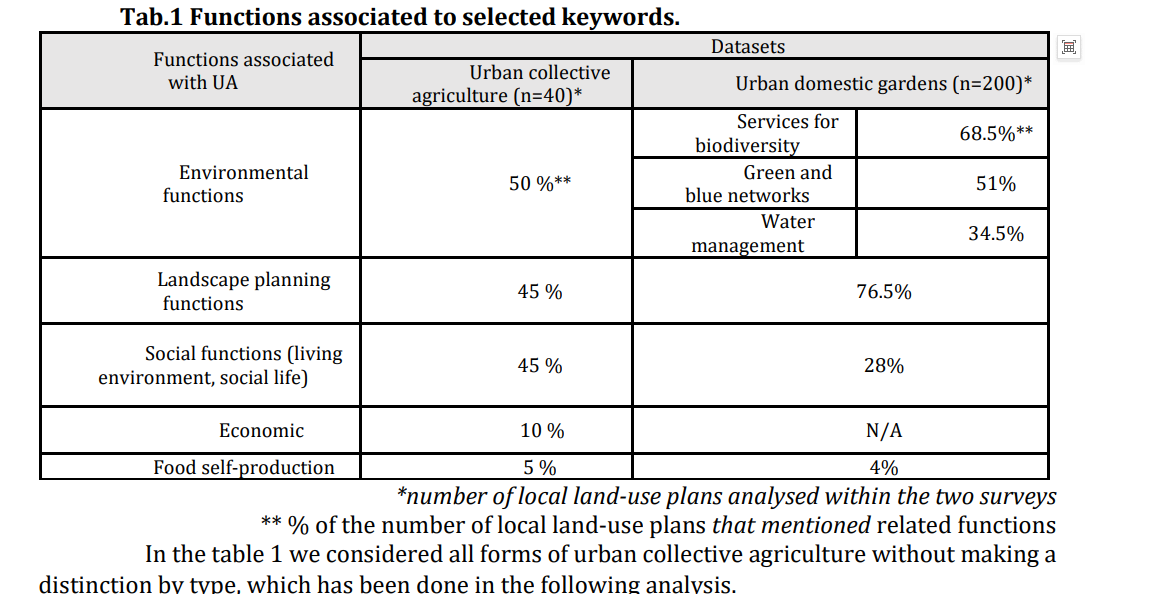
Environmental functions are one of the most highly quoted in the two datasets, all land�use plan parts combined. For urban collective agriculture, they are in first rank, quoted by 50% of municipalities they also appear to be a quarter of the total functions identified by the survey. They are related to allotment (46.8%) or community (23.4%) gardens and professional urban agriculture (14%). Most of these issues concern their contribution to the green grid and corridor, and biodiversity protection. There are specific features based on the UA types. Concerning professional urban agriculture, it is also cited as a tool to fight against heat islands and be more resilient to climate change. Furthermore, the roofs are identified to few municipalities as an undeveloped space to enhance those projects. Regarding community gardens those stakes are often associated with the social ones. For example, by emphasising that gardens are spaces where biodiversity and social bonds can be strengthened: ‘Biodiversity protection must be seen as an element of “living together”: community gardens or planted terraces, these spaces are meeting places that strengthen social ties, enabling people to play an active role in their well-being in the city’ (Nanterre, Local land-use plan).
Regarding UDG, biodiversity support functions are in second rank, after landscape functions and are quoted by 68.5% of local-land use plans. There, advantages of UDG for green and blue networks (51%) and for water management (34.5%) are less often quoted. One can see that municipalities do not have the same perception and management of risk (Baudelet, 2015).
The functions related to ‘landscape planning’ are quoted by 45% of the urban collective agriculture dataset and 76.5% of the UDG dataset. Two main issues emerge regarding urban collective agriculture. On the one hand, the desire to maintain and enhance UA areas to guarantee a balance between green and built spaces (42% of local land-use plans). The presence of green areas in some municipalities is also identified as characterising the territorial identity: ’Chevilly�Larue is an urbanised town with a combination of urban forms and an interweaving of planted and built-up areas that give it its identity and landscape.’ (Chevilly-Larue’s land-use plan). On the other hand, UA projects are indicated as a tool to manage the border and the fringes (17% of local land�use plans). For UDG, landscape planning - first quoted function- is related to urbanisation fringe issues too. It is also cited related to residential area identity issues because they are recognised as an important element of this area’s aesthetics.
The social function emerged in second position for urban collective agriculture dataset (45%) and lowered down the ranking for the UDG dataset. Differences between urban agriculture forms emerge for the social dimension. Regarding UDG, they are associated with leisure and relaxation needs of inhabitants in an intimate space hidden by vegetation and also to the idea that UDG improve their living environment beyond private areas boundaries by greening streets.
The economic functions are cited only by 10% both of municipalities and issues count and it is related to professional urban agriculture. In the Morangis PLU, urban agriculture is perceived as a tool for revitalising agricultural areas suggesting innovative projects and activities. In other municipalities it is more traditionally identified as promoting local activities that encourage short chains and local production. For UDG, this dimension didn’t rise during the inductive thematic analysis given the non-market nature of individual gardening. The economic benefits of self-produced food for households were not discussed either.
Among the least mentioned is the food function. The issue of self-production is mentioned by only 4% of municipalities. Paradoxically, the feeding function of vegetable gardens is emphasised more often, not for human consumption, but for wildlife. They are thus seen as favourable to urban biodiversity: “Orchards, gardens and, more generally, the ‘urban’ environment should be taken into account for their ecological function, particularly those linked to older housing, which can host and provide food resources for a whole range of wildlife adapted to these environments.” (Bouray-sur-Juine’s land-use plan). Concerning urban collective agriculture, the supply function is cited only in two plans and it is associated with allotment and community gardens.
5.3 Implementation in planning bylaws
So far, we focused our analysis on the more descriptive parts (overview reports, strategic projects and urban design guidelines), where the issues and functions associated with urban agriculture are detailed. Planning rules and land-use restrictions required to achieve the objectives are set up in the regulatory section (zoning by-laws), in line with the strategic development vision. The bylaw is binding on all public and private bodies for the execution of any works or constructions and specifies the use of the land (use, nature of activities). The affectation uses are regulated by zoning according to the French Urban Planning Code: ‘Urban zones’ for already urbanised areas (i.e. developed areas already served by water and electricity networks), ‘development zones’ for underdevelopment zone, ‘agricultural zones” for fields and others cultivated areas and ‘natural zones” for forests, meadows and other areas of environmental interest. Each type of zone permits or prohibits specific land uses. For the dataset on collective urban agriculture, we analysed which of these zoning types was used to classify the surface areas occupied by allotment gardens, micro-farms and so on.
Almost half of the documents analysed do not address collective urban agriculture in their bylaws. Furthermore, their integration into urban planning is often limited to farm building regulations. The rules often concern the size of garden sheds regarding allotment gardens or infrastructures for urban agriculture. The Urban Planning Code does not identify an exclusive zoning for urban agriculture. Most cases of collective urban agriculture are in urban zones, often those designated for green spaces.
In limited cases, urban agriculture projects are allocated to natural zones or agricultural zones. Natural zones are the least chosen. As an example, the municipality of Vitry-sur-Seine used a specific zoning defined as a ‘reserved for allotments or collective garden sites’ (Vitry’s land use plan). The Montreuil’s land-use plan zoned the major agricultural area of traditional orchards as agricultural zones and the municipality identified a “derogatory area”. These derogatory areas are defined in the Urban planning code as “sectors with limited size and capacity” where limited building rights are allocated although in agricultural or natural zones.
In our survey on domestic gardens, we focused on sub-zonings of urban areas. Municipalities may use different kinds of rules, set out in bylaws such as sub-zonings which limit the uses and actions on both public and private land within a freely defined perimeter of the urban territory.
First, land-use plans may delimitate sectors for ‘protected cultivated land’ in urbanised zones. It applies to allotment gardens, tree nurseries, orchards and any other land with agricultural vocation. In the law, the rationale of this protective sub-zoning is to maintain biodiversity and ecological corridors: ‘It may locate, in urban areas, cultivated land and undeveloped areas necessary to maintain ecological continuities to be protected and non�constructible regardless of the facilities, if any, that serve them.’ (Article L.151-23, Urban Planning Code). It is also used in setting up landscape buffer zones in some municipalities: “It should also be noted that to preserve landscapes, a steeper setback from agricultural and natural zones is imposed in the parts of land covered by the ‘cultivated land to be protected’ grid in order to ensure smoother landscape transitions.” (Longevlliers’ land-use plan). However, no prior declaration is required for work on or removal of orchards. Furthermore, there are no specific rules to guarantee the quality of cultivated soil, or to ensure the continued presence of certain inherited or vulnerable cultivated species.
For a stricter protection, municipalities may therefore choose to classify their domestic gardens as ‘landscape features’, which gives them greater control over their land use. To justify this classification, municipalities have to explain the contribution of gardens to urban landscapes: ‘A significant amount of greenery, in the form of vegetable gardens, fruit trees and climbing plants on the party walls bordering the Yvette, gives the whole area a rural feel.’ (Bures-sur-Yvette’s land�use plan).
More indirectly, vegetable gardens also appear to be a positive externality on land that has been classified as unbuildable due to natural hazards. As for example, as illustrated in the same municipality: ‘We do have a few plots that remain, particularly at the bottom of neighbourhood, on the banks of the Yvette, so we are in a flood-risk area. So, thanks to that, it has kept a bit of its use as a vegetable garden’ (interview with an elected local official in charge of urban planning, municipality of Bures-sur-Yvette). In other cases, protection rules for natural spaces may limit cultivation. as illustrated here by an interview with a private planning consultant: “The possibility of installing a garden shed or cultivation may be blocked by prescribing too many trees (…).”. Similarly, in most municipalities studied, legal uncertainty surrounding infrastructures such as greenhouses, resulting from poor foresight by planning authorities and consultants, may be a disincentive to the establishment of perennial crops in domestic gardens.
6. Discussion
6.1. Integration of UA and UDGs in urban planning is heterogeneous
Our findings reveal that UA and UDGs are issues which are not largely addressed in studied land-use plans. Moreover, it has been observed a diversity among municipalities based on their territorial context and willingness to integrate or not this matter in their political and territorial project. Even when this topic is addressed, we observe that they are regarded more in the overview section of the local land-use plan than in regulatory sections.
Other unequal treatment also appears according to the urban agriculture forms. If the UDGs are almost always considered because they are associated with specific urban fabric (suburban area or individual housing), our results regarding the collective urban agriculture confirmed, as demonstrated by Consalès et al. (2018), that the allotment gardens are one of the forms of UA best considered by urban planning.
6.2. Food function is poorly addressed in urban planning.
We would like to emphasise that not all functions are equally considered. If environmental, social and landscape planning functions and associated issues (biodiversity support, flood risk management, balancing of urban and unbuilt space, social bonding…) are more or less quoted, the food production function is largely omitted. We noted a discrepancy between the functions provided by UA identified in land-use plans and those highlighted in the academic literature. Although there is still no precise estimation of the food contribution as indicated in the introduction, some authors underline vegetable gardens contribution to the food resilience (Taylor and Lovell, 2014). They increase the food security of low-income individual households (Kumar and Nair, 2004; Buchmann, 2009; Siegner et al., 2018), decrease the vulnerability of households in times of economic, supply or other crises and enhance social resilience in unsecured context (Seeth et al., 1998; Buchmann, 2009).
One explanation is that urban planning policies in France are generally still insufficiently suited to precisely guiding the nature of agricultural activities. Indeed, French urban planning legislation specifies that urban planning can protect agricultural land, but do not have the role of guiding the type of agriculture in a given area. For local authorities, which are responsible for urban planning, urban agriculture poses new challenges that they are not always accustomed to dealing with and that require legal innovations. This is why it is easier for these authorities to deal with the environmental and social functions than food provisioning functions of urban agriculture, which relate to more traditional urban planning issues (promoting urban greening, creating spaces for social interaction). Furthermore, expertise in urban agriculture is still emerging with regard to the production practices to be implemented in the face of several challenges (technical systems, soil contamination, economic models for marketing products) (Aubry et al., 2022).
For UDG’s this lack of consideration from urban planning actors can be attributed to several factors: firstly, a difficulty in identifying the extent of the vegetable gardens within UDGs: aside from food production, UDGs support a diversity of practices. When they are cultivated, it is difficult, without photo-interpretation analysis, to identify the extent of cultivation.
Secondly, there appear to be some cultural obstacles. Indeed, there seems to be a prejudice on planners’ perceptions that any resident who owns a house with a garden would have an above-average income and would therefore have no economic interest in cultivating their own garden. However, some research conducted on vegetable gardens showed an important intra-urban variation in the spatial distribution of vegetable gardens depending on the social composition of neighbourhoods and the structure of the housing stock: proportion of houses with gardens, proportion of homeowners (McClintock, 2016; Marie, 2019) and parcel size (Darly et al., 2021).
Furthermore, drivers for self-production may have other purposes than just economic ones, as the literature on food production in UDGs and collective gardens has shown (Schupp and Sharp, 2012; Pourias et al., 2012) it can be led by rejection of unsustainable industrial food (Kortright and Wakefield 2011), cultivation of varieties or species that are not or no longer found locally - which could also be seen as an interest in the biological conservation of biodiversity (Aguilar-Støen et al., 2009; Galluzzi et al., 2010); or maintenance of inherited practices and varieties that contribute to the cultural identity of the inhabitants (Kortright and Wakefield, 2011; Mazumbar, 2012). However, the local urban plans analysed for this study do not take account of such issues. At urban planning scale, the food self-production is still not recognised as they should by cities to enhance local resilience.
6.3. In search of zoning regulations suited to the multifunctionality of agricultural spaces
Lastly, we would like to stress that they are no common and dedicated planning tools for UA regulation. UA projects are mostly classified in urban zones, but more rarely in natural and agricultural zones. This could be explained by the fact that the classification of an agricultural zone by national urban planning code is based on the agronomic, biological or economic potential of the agricultural land. Therefore, development rights are restricted and should be connected to agricultural activities. The urban and natural zones in some cases may be more relevant for environmental and social functions of UA. At the same time, planning regulations in urban zones allow a reversibility of land use (and greater flexibility for building rights supporting diversification in farming activities (conditioning, on-farm sale, agri-tourism, etc.). By contrast, agricultural zones may be more restrictive, except for derogatory areas. Aragau and Desrousseaux (2023) explored the difficulties and barriers to the implementation of agriculture into planning, through field surveys in the Ile-de-France region, and underlined that local planning authorities are reluctant to implement protective regulations for farming activities, in order to give some flexibility for future housing projects. But in some cases, local initiatives promoting re-territorialisation of agriculture may help to design adapted regulations for these farming activities. A better integration of agricultural activities in planning policies is in line with on-going initiatives to connect urban and food planning (Liu et al., 2024).
Furthermore, the adoption of the Climate and Resilience Act1 edicting the no net land take objective by 2050, will sharply limit consumption of agricultural and natural spaces and favour densification in already urbanised areas. However, according to recent implementation decrees (Decree nr. 2023-1096, 27 November 2023) a typology of urban soils has been drawn up in which ‘Areas used for residential purposes, secondary or tertiary production, or for infrastructure such as transport or logistics, where the soil is covered by herbaceous vegetation’ under 2500 m² – in which most of UA could belong- will be considered as artificialised and could be used in building projects. If UA projects are not designed and protected over a long-term period, they may be vulnerable to pressure on land in a context of intensifying urbanisation. In our opinion, the ability of stakeholders to perceive issues involved in this relocation of agriculture within cities is the main condition for the introduction of regulation protecting urban agriculture.
Our study also leads to recommendations for a dedicated legal framework (with both flexible and protective zoning) taking into account all the functions and related differences among the urban agriculture types. We suggest that specific assessment tools could be designed for UA, providing analysis of their potential contribution to local food consumption and to ecosystem services taking account of spatialised social inequalities (Qiu et al., 2023). All forms being multifunctional, it remains a specificity linked to the vocation of market or non-market production. The challenges among the different forms of UA are not the same: a distinction should be made among the amateur gardening and the professional urban agriculture. The challenge is to be able to manage the trade-offs between social, environmental and food production functions according to the specific vocation of those different forms.
7. Conclusions and insights for Chinese planning policies
The survey conducted on 240 local land-use plans and their integration of UA and UDGs functions and issues highlight that the most expected functions are related to environment, landscape management and social dimensions. The economic and food production functions are limited and not considered yet. These findings are consistent with the analysis of bylaws (which concerns in particular urban and natural zones). With our approach taking into account the various forms of urban agriculture, we were able to show that both domestic garden and collective agriculture functions need a better understanding of their functions and better tools in local land-use plans for cities’ resilience.
Rethinking the place of agriculture in the city for climate resilience has become all the more urgent in the context of no net land take policies, which recently led to the adoption of the Climate and Resilience Act. Local authorities should increasingly be looking at the place of non�urbanised spaces and the greening of cities through UA and UDGs’ protection. Urban agriculture and urban domestic gardens are likely to contribute to cities’ resilience at the lever for climate change adaptation but also for food provisioning. To be more effective the land-use planning should be integrated. Policies at a greater scale and sensitisation of local stakeholders on UA’s function could lead to a better integration of environmental, social, and economic resilience provided by UA in local land-use plans.
Although China and France are at different stages of societal development and operate under distinct governance systems, both countries face similar tensions between urban spatial optimization and green space preservation in the context of accelerating urbanization, increasing land scarcity, and the urgent need to address climate change. In China's current territorial spatial planning system, urban agriculture has yet to secure a meaningful position. Its value and management as a multifunctional green and agricultural space remain under-recognized. However, in recent years, spontaneous practices by urban residents—such as growing vegetables 1 Law n° 2023-630, 20 July 2023, facilitate the implementation of objectives to reduce land take and strengthen support for local elected representatives. In residential green spaces, establishing community gardens in public areas, and the rise of multifunctional peri-urban farms—have demonstrated both a real societal demand and strong development potential for urban agriculture in Chinese cities. These practices reflect not only a public call for access to green space but also the considerable potential of urban agriculture to mitigate tensions between urban expansion and ecological conservation, while enhancing urban resilience. Therefore, it is essential to systematically integrate urban agriculture into China’s planning frameworks, using scientific guidance and differentiated management to maximize its role in climate adaptation and green urban development.
(1) Systematically integrating urban agriculture into local planning and highlighting its multifunctional value
First, it is recommended that urban agriculture be fully integrated into local planning, with a clear recognition of its ecological, social, and landscape functions. Urban agriculture is not limited to food production; it also contributes to biodiversity, moderates urban microclimates, reduces stormwater runoff, and strengthens community cohesion. As part of blue-green infrastructure systems, urban agriculture can serve as important nodes and buffer zones in spatial configurations. These functions vary across different forms of urban agriculture, and thus local planning should identify and differentiate types such as household gardens, community gardens, educational farms, and professional urban farms within planning practices. Given that China’s local governments hold significant authority over land development and plan implementation, it is advisable to use policy guidance and performance evaluation mechanisms to enhance local governments’ systemic understanding of urban agriculture. Spatial attributes and functional roles should be clearly defined across urban, agricultural, and ecological land use categories.
(2) Refining classification and zoning systems and clarifying the legal status of urban agriculture
Second, efforts should be made to incorporate urban agriculture into the statutory planning system, with explicit legal status and spatial boundaries. Considering the intense competition for land in China, a more refined system of land-use classification and zoning should be established based on the diverse functions of urban agriculture. For example, distinct designations could be made for household gardening spaces within residential areas, community�shared garden plots, and professionally managed urban agricultural zones. Each category should be matched with appropriate management and protection policies. Currently, the Guidelines for Territorial Spatial Surveys, Planning, and Land and Sea Use Control Classification offer only general classifications; in practice, community gardens are often classified into "park green space," and vegetable plots in residential areas are classified as "urban residential land." This leads to ambiguity and weak protection in management. During local planning processes, we recommend a more granular classification based on actual use and the development of targeted regulatory protections and flexible development guidelines to ensure both security and growth opportunities for urban agriculture.
(3) Promoting governance coordination and public participation to strengthen the role of urban agriculture in urban resilience
Finally, multi-level policy incentives, interdepartmental coordination mechanisms, and inclusive public participation should be employed to enhance awareness and practical capacity for leveraging the multifunctional values of urban agriculture. Within the framework of “integrated multi-plan coordination”, it is critical to harmonize the relationships between ecological protection redlines, permanent basic farmland, and urban green infrastructure. Various forms of urban agriculture should be incorporated into the broader strategy for building urban resilience. By providing guidance and training for local stakeholders, developing urban�level functional evaluation systems, and encouraging residents to engage in garden maintenance and management, urban agriculture can serve as a vital connector between nature and urban life, a tool for strengthening social resilience, and a key driver of ecological civilization.
Acknowledgments
The authors acknowledge the support of the CBASC (Université Paris Saclay) for their founding of PERIJARDIN project, and the French National Research Agency (ANR) for their funding of GARLAND project. Furthermore, the authors thank Valentine Temple for having carried out preliminary investigations in the framework of the SEMOIRS project (2018-2020) funded by ADEME and Oriane Bonnal that continued those investigations thanks to Urban Agriculture Chair of ParisTech Fundation funding.